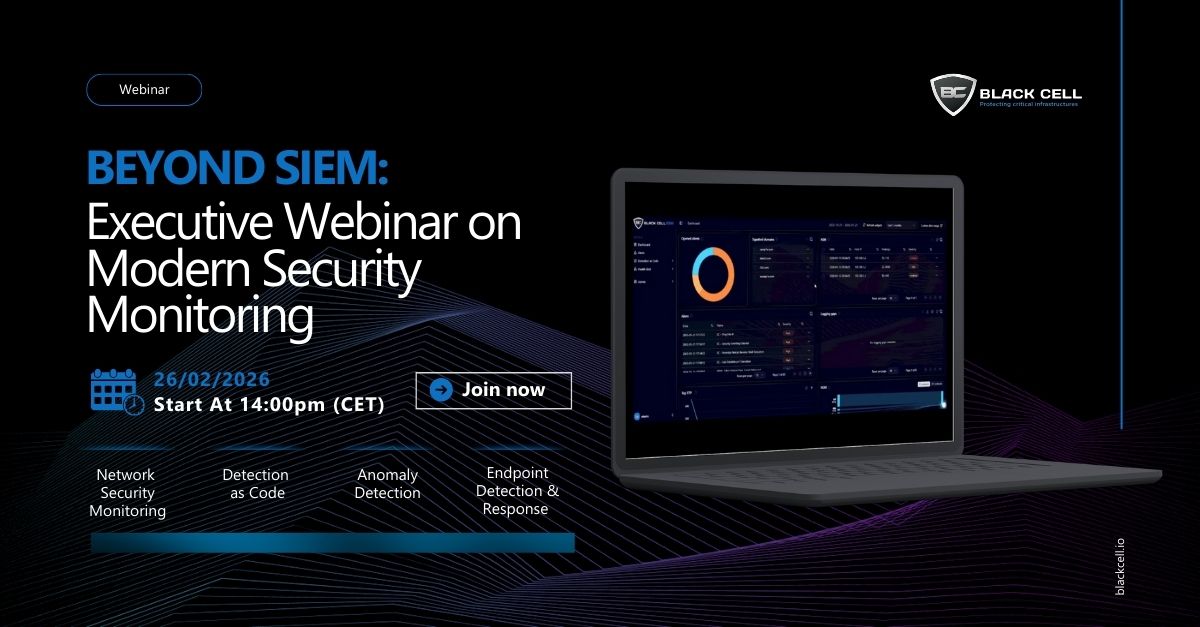
Black Cell is proud to share that proprietary ESM (Enterprise Security Monitoring) platform has been officially accepted into the Tech Sovereignty Catalogue. This is an important recognition within the European technology landscape and a significant milestone for our team. It also makes Black Cell ESM the first Hungarian technology listed in the Catalogue.
Why does technology sovereignty matter?
Europe is working to reduce its dependence on external providers for core digital infrastructure. According to the Tech Sovereignty Catalogue more than 80 percent of the digital technologies used across the continent originate from outside the EU; and in the cloud sector alone, more than 70 percent of the market is controlled by three US hyperscalers. This creates vulnerabilities in areas such as data control, supply chain resilience and strategic decision making.
When technologies are built and hosted outside of our bloc, the surrounding capital, talent and intellectual property flows there as well. In times of geopolitical tension, relying on foreign providers for critical infrastructure can create unnecessary risks. As outlined in Mario Draghi’s landmark piece on EU competetiveness, our continent needs dependable, locally controlled technologies that allow institutions, companies and citizens to operate securely.
The Tech Sovereignty Catalogue was created to help address this challenge. It maps European-owned and -controlled solutions that can strengthen the EU’s ability to operate and innovate independently. It also helps policymakers and industry partners discover mature, market ready European technologies.
What makes Black Cell ESM a sovereign solution?
Black Cell ESM was developed entirely within the European Union and is operated on infrastructure located in the EU/EEA. Our primary operational hubs are in Budapest and Frankfurt. The platform provides advanced threat detection, cyber resilience, and cyber common operational picture (CyCOP) capabilities. It is built on three integrated components:
- ESM enabling log management, event correlation, besides advanced EDR functionality, and anomaly detections
- Detection as Code (DaC) allowing rule development and distribution using version control, automated validation and rapid deployment through CI/CD pipelines
- Network Security Monitoring which adds deep visibility across IT and OT or ICS networks
- Advanced local RAG LLM based investigation support, running on dedicated appliances, in the customer’s infrastructure.
These capabilities form the technological foundation of Black Cell’s managed detection and response service. Black Cell’s ESM and the advanced log collection, infrastructure visibility and incident detection support compliance with EU regulations such as NIS2 and DORA that mandate organisations to increase their detection and reporting capabilities. Customers can use ESM as a hosted service inside the EU or deploy it on their own infrastructure. Self-hosting provides full control over data handling and operational governance.
About the Tech Sovereignty Catalogue
The Catalogue is part of a coordinated effort to build a more autonomous European technology stack. It brings together trusted European solutions across cloud, connectivity, cybersecurity, data and AI. It also connects innovators with policymakers and industry stakeholders who are seeking European alternatives. Each listed solution is reviewed for ownership, maturity, relevance and alignment with European strategic goals. Solutions are assessed through a structured framework that examines their capabilities, capacities and the degree of control that remains within Europe.

Author

Béla Droppa
Related Posts

Think Like an Attacker: Spot the Security Risks
Wi-Fi password posted on the wall ("Office-WiFi / Password: Office123!") Unattended laptop left...

The Extension Threat Vector: Protecting Browsers and Dev Environments?
If your organization doesn’t manage extensions and your users can freely install any browser and...
