Explore
Analyzing Gaps
in Detection Coverage with
MITRE ATT&CK
MITRE ATT&CK is a widely adopted framework that maps real-world adversary tactics and techniques, helping organizations understand how attackers operate across the attack lifecycle. Rather than focusing on specific malware or tools, it provides a structured view of attacker behavior that supports threat modeling, detection engineering, and security assessments.
Black Cell’s MITRE ATT&CK Gap Assessment uses this framework to evaluate the organization’s visibility and detection capabilities across endpoints, identities, networks, cloud services, and applications. The assessment identifies security monitoring and detection gaps, measures ATT&CK coverage, and prioritizes improvements based on risk, enabling organizations to strengthen their defenses and focus remediation efforts where they will have the greatest impact.

What We Do
A structured assessment of visibility, log collection and detection coverage
The assessment evaluates how effectively your current environment can support the detection of adversary tactics, techniques and procedures that are relevant to your organization. It considers the infrastructure and security technologies already in place, the telemetry they can generate, the extent to which that telemetry is centrally collected, and the detection logic available to turn it into actionable security outcomes.
The methodology
The outcome is not a product inventory or a simple checklist. It is an evidence-based view of whether your existing controls provide the visibility and detection capability needed across the applicable attack surface, together with a prioritized plan for closing the most important gaps.
Environment and data collection
We establish the relevant infrastructure, attack surface, security solutions, available log sources and the extent of their deployment. Inputs may include questionnaires, workshops, inventories, system configurations and access to relevant security platforms.
Data-source mapping
We map the identified log sources and security capabilities to MITRE ATT&CK data source components. This shows whether the telemetry required to observe a technique is available across the systems to which that technique applies.
Log-collection analysis
We assess whether applicable telemetry is actually forwarded to a centralized security monitoring or log-management platform. This distinguishes data that may exist locally from data that analysts can use for correlation, investigation and retention.
Detection-capability analysis
We review available detection capabilities by examining SIEM or security analytics rules, relevant system configurations, vendor documentation and MITRE guidance. A detection is credited only where the supporting telemetry and applicable attack-surface coverage make it operationally meaningful.
Scoring, threat context and prioritization
Data-source coverage, centralized collection and detection coverage are combined into technique-level scores and visualized in ATT&CK heatmaps. Where included in scope, sector-specific adversary activity is mapped to ATT&CK so that weaknesses can be prioritized according to both environmental exposure and relevant threat behaviour.

Explore
The benefits
By conducting a MITRE ATT&CK-based Gap Assessment, your organization gains a defensible view of detection maturity and a practical basis for security improvement.
What are the key benefits?
- Expose visibility gaps: Identify poorly monitored systems, data sources, and ATT&CK techniques, including telemetry that is not centrally collected.
- Link controls to outcomes: Understand which technologies improve visibility and detection, and where coverage gaps or overlaps exist.
- Prioritize remediation: Focus investments on the gaps that create the greatest security risk.
- Create a shared roadmap: Align SOC, security, infrastructure, and management teams around ATT&CK-based improvements.
- Align with real threats: Compare weaknesses against relevant adversary techniques and attack trends.
- Track progress: Measure improvements over time using a consistent, repeatable assessment baseline.
Visibility Gaps
Identify areas lacking oversight in your organization.
Operational Efficiency
Assess the effectiveness of your security tools, red team and SOC.
Threat Blind Spots
Identify hidden attack vectors invisible to your current security stack.
Security Investment
Pinpoint gaps to enhance cybersecurity programs.

Explore
Deliverables
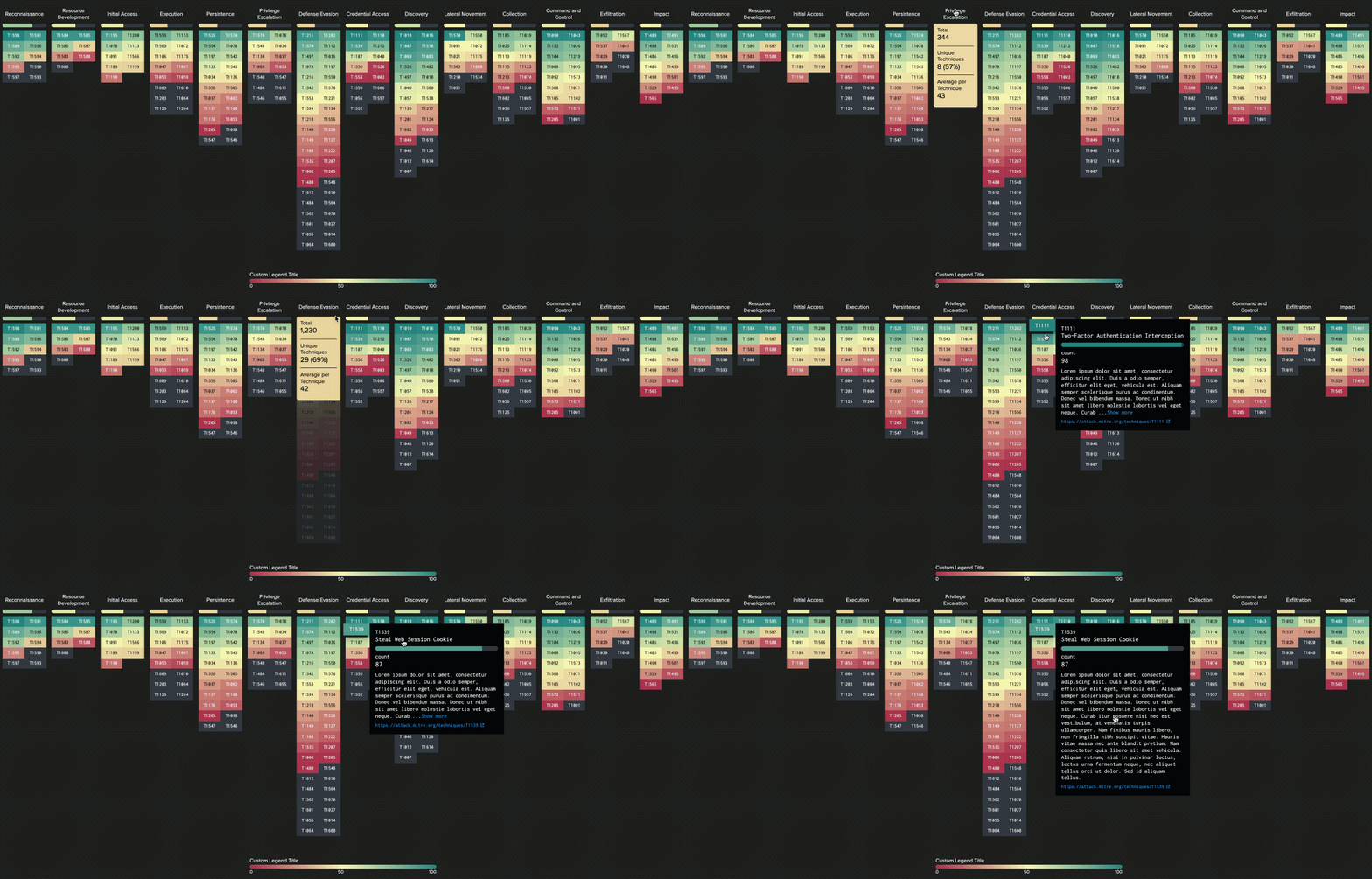
ATT&CK coverage and priority heatmaps
The assessment presents technique-level results in visual ATT&CK matrices, making areas of stronger and weaker coverage easy to understand. The visualizations distinguish the organization’s current defensive coverage from the relative priority of techniques and support a concise management view of where improvement is most urgent. Techniques that are not applicable to the assessed environment are identified separately rather than treated as security gaps.
Detailed gap analysis report
The primary deliverable is a detailed, customer-specific report. It documents the assessment scope and methodology, explains how coverage is calculated, and provides the evidence and context needed to understand the results. The report is designed to support technical remediation while also giving decision-makers a traceable basis for prioritization and investment.
The report
Depending on the agreed scope and available evidence, the report provides practical detail that remains useful after the assessment.
Environment Overview
An overview of the assessed environment, relevant infrastructure, security technologies and data sources.
Assessment Methodology
Explanation of log-source coverage, centralized collection and detection capability evaluation.
Data Source Coverage
Coverage tables mapped to MITRE ATT&CK data source components.
Detection Analysis
Assessment of detection capabilities, security products, configurations and analytics content.
ATT&CK Coverage & Threat Mapping
Overall ATT&CK coverage matrix and sector-specific threat heatmap.
Prioritized Action Plan
Heatmap-driven remediation roadmap based on coverage and threat context.
Technique-Level Findings
Recommendations
Tailored guidance for improving telemetry, detection engineering and security architecture.